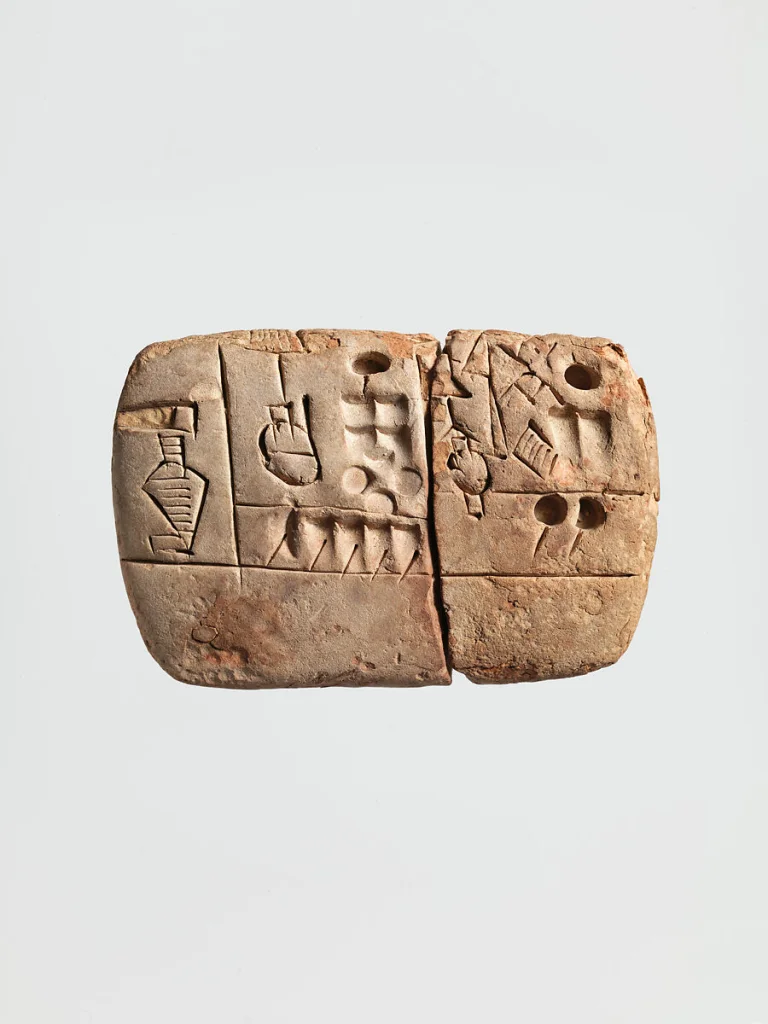
Cuneiform is a family of writing systems named for the wedge impressions in its signs. Its early forms are attested at Uruk in southern Mesopotamia in the late fourth millennium BCE. Many surviving early tablets kept track of goods or labor. One small tablet in The Met records malt and barley groats, evidence of the kinds of transactions people needed to remember.
How did scribes make the wedges?
Scribes pressed the end of a cut reed or wooden stylus into damp clay. A change of angle or direction made a different wedge, and groups of wedges formed signs. Some early signs had a recognizable pictorial shape. As the system changed, the wedges grew more conventional and a picture alone became an unreliable guide to the reading. Clay tablets were common, and inscriptions could also be cut into stone.
Which languages used cuneiform?
Sumerian was one of the first languages written with the script. Scribes adapted it to write Akkadian, including its Babylonian and Assyrian varieties, as well as other languages such as Hittite. The shape and use of a sign could change across centuries and places. By the third millennium BCE, people were using cuneiform for far more than records of goods, including letters, laws, literary works and scholarly texts.
How do cuneiform signs represent words and sounds?
A sign could stand for a whole word, a syllable or a clue to the category of a nearby word. For example, the AN sign can stand for the Sumerian word an, meaning sky, or carry other readings according to context. A short name can be approximated with signs read as syllables. Luna can be rendered as lu-na. The order shows a possible way to spell the sound of the name, and the same signs can have different values in an ancient text.
What does a tablet translation require?
Start with the collection record for the object and identify its date, language and place of origin. A transliteration writes the identified sign readings in Latin characters, often with hyphens and subscripts. A translation interprets the words and grammar of that reading. Compare a published transliteration with a museum or scholarly translation before assigning a meaning to a sign you found in isolation. For a photographed object, damage and the angle of the light can make the first step of recognizing the wedges difficult.
Why do copied cuneiform signs sometimes display as squares?
Unicode encodes signs as characters, and a compatible font provides the visible wedges. Use a cuneiform font such as Noto Sans Cuneiform for editable text. A PNG preserves the visible shapes when you share a label or illustration with someone who may have a different set of fonts.